
How to Test Dropshipping Products in 2026 (Without Burning $300 on Ads)
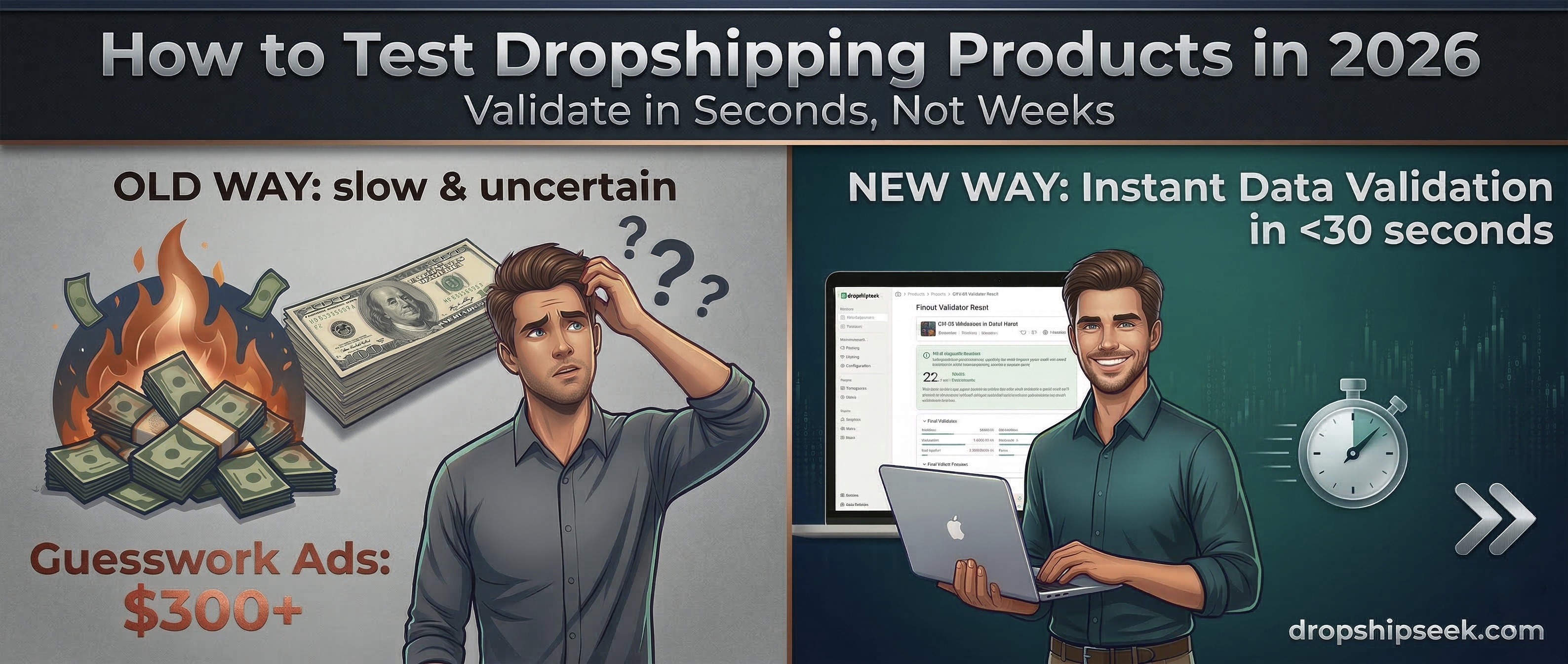
The real cost of testing isn't the ad spend — it's testing the wrong products. Here's how to cut your per-product cost from $300 to $50.
I tracked every product I touched in Q1. Out of 140+ I looked at, only 9 survived the full validation process and got an actual ad test. Of those 9, 2 became genuinely profitable and a third is borderline — still scaling. That's roughly a 1-in-4 hit rate on the products I chose to test.
Compare that to the industry default: test everything, pray for 5–10% success, burn $2,000–$5,000 before finding a single winner.
The difference is 30 seconds of checking data before spending $1 on ads.
The $300 Product Test Is a Lie
Here's what a single "product test" actually costs in 2026:
| Step | What You Do | Real Cost |
|---|---|---|
| Find product | Scroll TikTok or a spy tool, get excited | $0 (but 2–4 hours) |
| Build product page | Import images, write copy, set up store | 2–4 hours |
| Create ad creative | Film, edit, or pay someone | $50–$200 |
| Run ads for 3–5 days | $50–$100/day on Meta or TikTok | $150–$500 |
| Analyze results | Stare at inconclusive data | $0 |
| Total per product | $200–$700 |
At a 5–10% success rate, that's 10–20 cycles before something works. $2,000–$14,000 in sunk costs — on products that a 30-second data check would have killed instantly.
Validation vs. Testing: They're Not the Same Thing
This is where most guides — including my last one, honestly — blur the line. Let me be precise:
| Validation | Testing | |
|---|---|---|
| When | Before any spend | After validation passes |
| Cost | $0 (or cost of a data tool) | $50–$150 per product |
| Time | 30–60 seconds | 2–3 days |
| What it tells you | Should I even bother? | Can I scale this? |
| Kill rate | ~90% of products eliminated | ~20–30% of validated products become profitable |
Validation is the filter. Testing is the proof. You need both — but in that order.
The 5 Signals That Kill a Product Before You Spend a Dollar
Every product I validate goes through five checkpoints. Miss one, and it's a skip.
Signal 1: Market Score
A composite viability score that weighs demand, margin, competition, and trend direction. Think of it as a single number that answers: "Is this product worth my time?"
| Score Range | What It Means | Action |
|---|---|---|
| 0–3 | Danger Zone. High saturation or margins below 15%. | Skip immediately. |
| 3–5 | Grind Zone. Profitable in theory, painful in practice. | Skip unless you have a unique angle. |
| 5–7 | Sweet Spot. Healthy demand, solid margins, manageable competition. | Validate further → test. |
| 7–10 | Unicorn. Massive demand, 50%+ margin, near-zero competition. Rare. | Drop everything, test today. |
How to check manually: You can't easily — this requires weighting multiple data sources. This is where a validation tool earns its keep. DropshipSeek's Product Validator calculates this as a Success Score (0–100) by pulling live data from AliExpress, Google Trends, Amazon, and active Shopify stores simultaneously.
Last Tuesday, I checked a silicone kitchen gadget. Score: 72/100. Demand was high, only 14 DTC sellers detected, trend sharply rising. Verdict: test it now, not tomorrow.
Signal 2: Competition Density (Saturation)
The single most overlooked signal. If 200 stores already sell your product, you're entering a price war.
| Saturation Level | What It Tells You |
|---|---|
| Very Low (< 15 sellers) | Wide open. Move fast. |
| Low (15–40 sellers) | Room to compete with decent creative. |
| Medium (40–80 sellers) | Getting crowded. Need strong differentiation. |
| High (80–150 sellers) | Tight. Only viable if demand is strongly rising. |
| Saturated (150+) | Every ad dollar fights 200 other sellers. Walk away. |
How to check manually:
- Google:
"[product name]" site:myshopify.com— count results on the first 3 pages - Check Facebook Ad Library for active ads with the same product
- Search TikTok Shop for the product name
Here's what most people get wrong: they check Amazon review counts as a proxy for competition. A product with 50,000 reviews isn't necessarily saturated for DTC — it might have only 8 Shopify sellers. Reviews measure historical sales volume. What matters is how many sellers are competing for DTC customers right now.
The shortcut: DropshipSeek scans live seller density, Shopify store presence, and active ad saturation levels and gives you a saturation rating in seconds — no manual Googling required.
Signal 3: Trend Direction
A product's search trend tells you where demand is heading. Rising = opportunity. Flat = mature market. Declining = too late.
| Trend Pattern | Meaning |
|---|---|
| Rising (last 30 days) | Demand growing — good entry signal |
| Flat | Mature market, harder to compete without differentiation |
| Declining | You're late. Window is closing or closed. |
| Spike + decline | Viral moment passed. Don't chase it. |
| Seasonal cycle | Can work if you time it right |
How to check manually: Google Trends → search your product → set to "Past 12 months" and "Past 90 days." Look for upward trajectory in the last 30 days specifically.
What you're looking for: a rising trend combined with low saturation. That combination — growing demand with few sellers — is the entire game. A product with stable trends and moderate competition? That's a grind. You can make it work, but it'll cost more and take longer.
Signal 4: Margin Health
If your margin is under 2.5x, you can't afford customer acquisition costs on Meta or TikTok. Full stop.
| Metric | Threshold | Why |
|---|---|---|
| Margin % | ≥ 50% | Below this, post-CAC profit evaporates |
| Net Profit per unit | ≥ $8 | Below $8, you can't absorb a $15–$25 CPA |
| Markup ratio | ≥ 2.5x | Minimum runway for sustainable ad spend |
How to check manually:
- Find the product cost on AliExpress (including shipping)
- Check what competitors actually charge — not what you want to charge. If 10 stores sell it at $24.99, you're selling it at ~$24.99.
- Calculate:
Selling Price / (Product Cost + Shipping)— needs to be ≥ 2.5x
Example: Cost $4.20, sell at $19.99 = $15.79 spread. A $25 CPA still leaves $5+ profit per unit after fees. That's a product with room to breathe.
But: $12.50 cost, $22.99 sell = $10.49 spread. After a $15 CPA and platform fees, you're losing money on every sale. The margin looked fine until you factored in real ad costs.
The shortcut: DropshipSeek pulls the supplier cost and competitive median retail price automatically, then calculates realistic post-CAC profitability — so you don't have to spreadsheet every product manually.
Signal 5: Advertising Viability
Some products look great on paper but are untestable in practice.
Check for:
- Is it in a restricted ad category? Health claims, before/after imagery, weapons — Meta will throttle or ban your ads.
- Does it require a video demo to understand? If yes, and you don't do video, it's a mismatch.
- Is there a clear visual hook? Can you stop a thumb-scroll with one image?
- Are competitors running ads successfully? Check Facebook Ad Library.
- Danger flags: Fragile? Battery restrictions? Sizing/return risk? Regulatory issues?
A product can score a 7/10 on every other signal and still be untestable if it's a supplement requiring health claims or a product so complex it needs a 60-second explainer you're not equipped to make.
General Store vs. Niche Store: Let the Data Decide
Quick answer: it depends on how many validated products you can find in one vertical.
| Factor | General Store | Niche Store |
|---|---|---|
| Testing speed | Fast — test any category | Slow — limited to one vertical |
| Brand equity | None. You're a billboard. | High. Repeat customers, lower CAC over time. |
| Best for | Beginners validating their first 20 products | Operators who found a winning niche |
| Conversion rate | 1–2% typical | 2–4% for well-built niche stores |
| When to use | You don't know your niche yet | You've validated 3+ winners in the same category |
Practical test: search a niche keyword and filter for products with a Market Score ≥ 5, competition ≤ Medium, and net profit ≥ $8. If you get 15+ passing products in one niche, that's enough white space for a branded store. If you get 3–5, run a general store until you find a niche with more room.
The $50 Product Test: How to Test After Validation
Once a product passes all five signals, here's the framework that replaced my $300 habit:
Phase 1: Micro-Test ($20–$50)
| Action | Cost | Duration |
|---|---|---|
| Import product to Shopify | $0 | 15–60 min (or seconds with DropshipSeek's 1-Click Sync) |
| Create 2 static image ads (Canva + product photos) | $0 | 30 min |
| Run 1 CBO campaign, 2 ad sets, $10–$15/day on Meta | $20–$45 | 2–3 days |
To be clear: $50 won't prove a winner. That takes Phase 3. What $50 does is catch losers early — the products with a 0.4% CTR and zero add-to-carts that would've eaten $300 before you pulled the plug.
You're looking for minimum signal: CTR above 1.5%, Cost Per Add-to-Cart under $5, and ideally at least one purchase.
Phase 2: Confirm or Kill (Day 3)
After 2–3 days and $20–$50 in spend:
| Metric | Continue | Kill |
|---|---|---|
| CTR (link) | > 1.5% | < 1.0% |
| CPC | < $1.50 | > $2.50 |
| Add to Carts | 3+ | 0–1 |
| Purchases | 1+ | 0 |
| Cost per Purchase | < 2x target | > 3x target |
Kill decisively. If the numbers don't show signal after $30–$50, the product isn't dead — your entry point might be. Has saturation increased since you first checked? If so, the window closed while you were testing. This happens. Move on.
Phase 3: Scale ($100–$300)
Only products that show clear signal in Phase 1 get more budget. Now you're spending $50–$100/day with:
- 3–5 ad variations (video + static + carousel)
- Broader targeting
- Retargeting audiences from Phase 1
This is where the traditional $300 test budget goes — but only on products that already proved demand with $50.
Two Products, Two Outcomes
Product A: Portable Mini Projector
| Signal | Data | Verdict |
|---|---|---|
| Market Score | ~3.5/10 | Grind Zone |
| Saturation | High — 60+ active DTC sellers | Crowded |
| Trend | Flat, slight decline | Stagnant |
| Margin | $28.50 cost, $59.99 sell = 52% | Decent |
| Competition context | 45,000+ Amazon reviews, heavy ad presence | Saturated |
Decision: SKIP. The margin looked attractive in isolation, but everything else said no. High saturation, flat trend, and entrenched competition with 45,000 reviews. This would've cost $300 to learn what the data already showed in 30 seconds.
Product B: Ergonomic Laptop Riser (new design variant)
| Signal | Data | Verdict |
|---|---|---|
| Market Score | ~6.5/10 | Sweet Spot |
| Saturation | Very Low — < 15 active DTC sellers | Wide open |
| Trend | Rising sharply over 30 days | Growing fast |
| Margin | $6.80 cost, $29.99 sell = 77% | Strong |
| Competition context | ~800 Amazon reviews, minimal ad presence | Room to enter |
Decision: TEST IMMEDIATELY. Set a 3.5x markup, had ads running within 2 hours. Phase 1 micro-test came back with a 2.3% CTR and 5 purchases on $40 spend. Scaled to $100/day by Day 4.
The difference between these two products? Not instinct. Data.
4 Testing Mistakes That Keep Burning Your Budget
Mistake 1: Confusing Spy Tool Data With Validation
A spy tool shows you that someone ran an ad. It doesn't tell you the ad was profitable, the market isn't saturated now, or the window is still open. Spy data is historical — by the time it surfaces, dozens of sellers have already piled in. You need current data: live seller count, real-time trends, today's saturation level.
Mistake 2: Testing Too Long
If a product doesn't show signal after $50, it won't magically convert at $300. The "I just need more data" trap has cost more people more money than any bad product. Set a hard kill: $50 max for Phase 1.
Mistake 3: Choosing Products You Personally Like
Your taste is statistically irrelevant. Some of my best performers were products I'd never buy — ugly, niche, weirdly specific. But the data said go. The data doesn't care about your aesthetic preferences.
Mistake 4: Skipping the Filter Because a Product "Obviously" Works
Famous last words. The product that "obviously" works is the one 10,000 other people also think works. Check the data anyway. Always.
The Math: Validated Testing vs. Blind Testing
Same $1,500 monthly budget. Two approaches:
| Metric | Blind Testing | Validated Testing |
|---|---|---|
| Products evaluated | 5–6 | 50–80 |
| Products tested with ads | 5–6 | 4–6 (only those that pass) |
| Cost per test | $250–$300 | $50–$90 (micro-test phase) |
| Total ad spend | $1,500 | $200–$540 |
| Expected winners | 0–1 (5–10% hit rate) | 1–2 (20–30% on validated pool) |
| Budget remaining for scaling | $0 | $960–$1,300 |
| Time on research | 10–15 hours | 1–2 hours |
Instead of spending $1,500 to find a winner, you spend $300 to find one and have $1,200 left to scale it.
The 30-Second Pre-Test Checklist
Before you spend a dollar on any product:
| Step | What to Check | Pass/Fail |
|---|---|---|
| 1 | Market Score ≥ 5? | Below 5 → stop |
| 2 | Saturation ≤ Medium? | High or saturated → stop |
| 3 | Trend rising (last 30 days)? | Flat or declining → stop |
| 4 | Margin ≥ 50% with ≥ $8 net profit? | Below threshold → stop |
| 5 | No danger flags (fragile, restricted, regulatory)? | Flags present → stop |
You can check each of these manually using the methods described above. Or you can do all five simultaneously in 30 seconds — DropshipSeek's Product Validator runs every signal at once and gives you a single verdict: sell it, proceed with caution, or skip it.
Stop Paying the Ignorance Tax
Every product you test without checking the data first is a voluntary tax on your business. In 2026, with CPMs rising and product windows shrinking, that tax is steeper than ever.
The framework is simple: check the data, test only what passes, kill fast, scale what works. One validation takes 30 seconds. One failed test you skip saves $300.
Your next product is either a $300 lesson or a $50 discovery. The data knows which one before you do.